My research lies at the intersection of forest economics, international economics, economic geography, and urban economics. I use applied mathematics and data science—particularly graph theory and machine learning—alongside GIS and large-scale datasets (FAOSTAT, UN Comtrade, BACI) to study the structure and dynamics of the forest-wood sector, with a focus on trade and the forest-based bioeconomy.
In addition to my research, I coordinate the Forest Information and Resource Strategies (FIRS) major (M.Sc.2) at AgroParisTech, where I also teach forest economics, with a focus on international trade in wood products. You can learn more about the FIRS major in this video.
“The Rise (and Fall?) of China’s Demand for Imported Timber: A Network Analysis of the International Roundwood Trade” under revision in Forest Policy and Economics.
This paper offers the first comprehensive assessment of the trade effects of due diligence policies (e.g., the U.S. Lacey Act and the EU Timber Regulation) which are motivated by concerns over illegal logging in global timber markets. We use a structural gravity model with global timber trade data from 2000 to 2021 to estimate the impact of these regulations, differentiating effects based on an exporter’s risk profile and product type. We find that these policies act as a significant non-tariff barrier. Crucially, this deterrent effect is indiscriminate: we find no evidence that high-risk exporters are more constrained than compliant, low-risk exporters. This suggests that the substantial compliance costs and procedural barriers limit trade for all suppliers. We also show that these policies most strongly affect raw and lightly processed timber. Counterfactual simulations confirm that a risk-targeted policy–one that restricts due diligence obligations to high-risk exporters–could preserve overall trade volumes while effectively shifting sourcing away from risky suppliers. Our findings offer timely insights for global trade and environmental policy design, highlighting the need for refined, risk-calibrated mechanisms in emerging regulations such as the EU Deforestation Regulation (EUDR).
@article{mathieu2027indiscriminate,title={Indiscriminate barriers: The trade effects of due diligence policies in global timber markets},author={Mathieu, Valentin and Nedoncelle, Clément},keywords={Due diligence policies, Illegal logging, Wood products, International trade, Gravity model},journal={Ecological Economics},volume={251},pages={109184},year={2027},publisher={Elsevier},issn={0921-8009},doi={https://doi.org/10.1016/j.ecolecon.2026.109184},url={https://www.sciencedirect.com/science/article/pii/S0921800926002697},hal=hal-05708088,altmetric=true,}
ForPol
A meta-analysis on wood trade flow modeling concepts
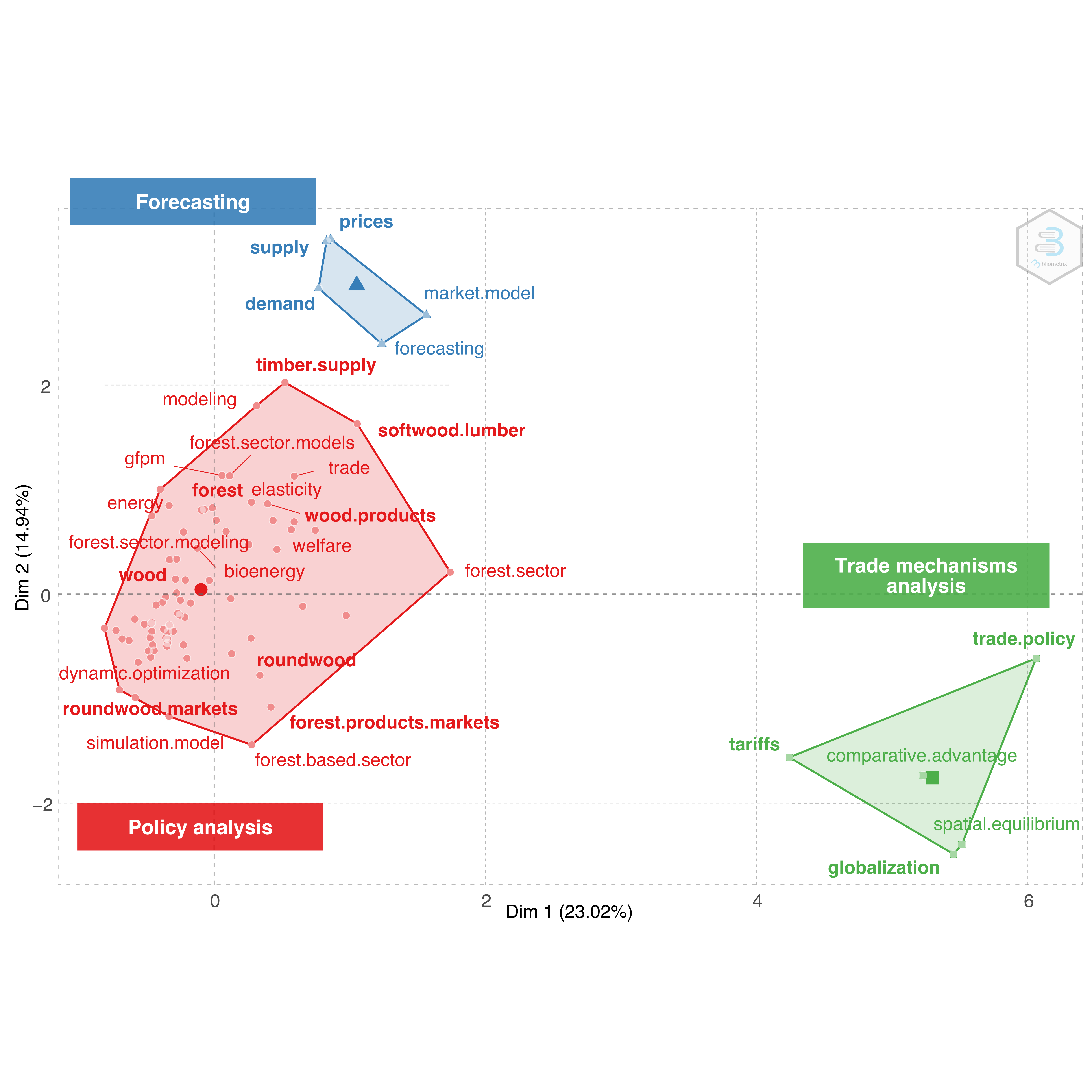
Papers on forests and forest products often address sustainability and climate change issues. Wood trade flow models study production and exchanges of wood products in order to better understand and analyze these issues. To date, there has not been a complete overview of these models’ objectives, or of the wood trade flow factors they use. We expect wood trade flow models with different objectives to rely on a wide diversity of factors. We performed a meta-analysis on 499 publications about wood trade flow modeling, published between 1972 and 2022 and recorded in the Scopus database. We found that three groups of model objectives constitute most of the literature: understanding trade mechanisms (5% of the literature), forecasting trends (9%), and policy analysis (99%). There is a degree of overlap between these categories, as 14% of the literature uses wood trade flow models for at least two of the latter objectives. Within the category of models exploring or simulating policies, about 37% of papers address major economic disruption issues, 40% concern environmental issues, while 49% relate to energy, welfare or trade policies. Altogether, these models use a narrow set of four categories of factors: price factors (6% of the literature), the interdependency of production factors (11%), policy factors (15%), and stock and trade quantity factors (49%), neglecting other possible factors. This study provides the first comprehensive overview and categorization of the models’ objectives in relation to their factors. Most importantly, the literature rarely uses certain factors that are considered in other commodities or economic sectors. In particular, the central role of urban dynamics in shaping material trade flows remains unexplored overall by wood trade flow modeling. Compared to the perception of what the driving forces of the forest sector economics have been in recent decades, new issues that have risen require the integration of new categories of factors.
@article{mathieu2023meta,title={A meta-analysis on wood trade flow modeling concepts},author={Mathieu, Valentin and Roda, Jean-Marc},journal={Forest Policy and Economics},volume={149},pages={102930},year={2023},publisher={Elsevier},doi={https://doi.org/10.1016/j.forpol.2023.102930},url={https://www.sciencedirect.com/science/article/pii/S1389934123000254?casa_token=oKOSGj9hx5EAAAAA:NnORceiXIEQL1REJ4_O5_Xr4oaxyqy5V3ckaRS51Mha8kTyY7wHK9yYb9AlI5Y1qHYR2es17-dciFg},hal=hal-04150977,altmetric=true,}
PhD Thesis
Wood, Cities, and Trade: An Economic Analysis of the Global Urban Demand for Wood Products and the Dynamics of International Wood Trade
To achieve sustainable development and sustainable natural resource management, a thorough understanding of the various factors that contribute to the wood economy, as well as an accurate forecast of wood supply and demand, are essential. Such analyses rely on models, referred to in this thesis as "wood trade flow models" when studying wood production, trade and consumption. The use of models to explain and predict economic phenomena comes up against several methodological difficulties. Given these difficulties, how can we assess a model’s ability to conduct such analyses? This thesis considers three essential and interdependent aspects of modeling to assess a model’s ability to achieve its objectives. The first is whether the theoretical framework of models can be tested empirically. The second aspect is to determine whether a model takes into account factors that are important for the heuristic and predictive analysis of economic phenomena. The third aspect concerns the availability and quality of data on which a theory can be tested and from which factors can be identified and quantified. This thesis is structured around these three aspects and is divided into four chapters. The first two chapters deal with two of the modeling aspects considered: (i) the factors taken into account or to be taken into account in modeling the wood economy, and (ii) the development of models based on empirically testable theories. The last two chapters deal with the third aspect of modelling: data quality and its implications for modelling. The aim of this thesis is to conduct a review of the factors considered in modeling wood trade flows, and to propose an economic analysis of urban demand for wood and international trade in wood products. Chapter 1 presents a meta-analysis of wood trade flow modeling concepts. It concludes that economic models rely on a narrow set of factor categories, thus neglecting other important factors, such as urbanization. Chapter 2 develops a spatial model of urban demand for wood. By taking urbanization into account as a factor in the global wood economy, the model offers a realistic and accurate representation of forest economic phenomena, suggesting a crucial role of urban dynamics in shaping the global wood economy. Chapter 3 highlights several discrepancies between export and import data, and proposes a method for accounting for measurement errors in trade analyses. This chapter suggests that these discrepancies are significant, and that failing to correct models for errors in trade data biases model results. Chapter 4 performs a network analysis of the roundwood trade. Although this analysis is primarily descriptive, it provides a realistic and mechanistic model for assessing the structure of the trade network and its dynamics. The scientific contributions of this thesis are threefold: it proposes new methods for modeling the global wood economy, integrates urban dynamics as a factor shaping the global wood economy, and highlights a need for best practices in the analysis of wood product trade. It addresses global issues by highlighting the need to anticipate future urban demand for wood, questions the effectiveness of economic regulation policies applied to forests and wood products, and suggests commercial strategies aimed at minimizing market risks.
@phdthesis{mathieu2023wood,title={Wood, Cities, and Trade: An Economic Analysis of the Global Urban Demand for Wood Products and the Dynamics of International Wood Trade},author={Mathieu, Valentin},year={2023},school={Universit{\'e} de Lorraine},url={https://theses.fr/2023LORR0267},hal=tel-04594758,}